
Most will argue that the design museum’s latest immersive exhibition couldn’t have arrived at a better time. ‘Rebel- 30 Years of London Fashion’, a collaboration between the design museum and the British Fashion Council (Lewin & Mower, 2023), pays tribute to the country’s modern fashion revolution at a time when funds for the arts are at a distressing low (Khomami, 2022). Despite recent hardships, the exhibit aims to reflect how ‘creativity is the superpower of this country’ (Turner, 2023). Curators Sarah Mower and Rebecca Lewin’s vision was to evoke the rebellious and underground nightlife culture that these designs were highly influenced by (Hess, 2023). From this perspective, I believe Mower and Lewin’s creation effectively portrays this period with flying colours.
Colourful Greetings and McQueen’s Legacy-
After being greeted by flashy screens of a variety of catwalk shows, my first impression of the exhibit was of fascination. ‘Colour Explosion’ helps to demonstrate the way vibrant colour has been used as a symbol of revolting against the drabness of city life, as a result of the recession in the early 90s (Lewin & Mower, 2023). While these bombastic designs speak for themselves, what makes this section particularly enticing are the coordinating backgrounds paired alongside them. From Richard Quinn’s signature floral pattern pairing perfectly with his metallic creation from his debut 2018 collection to Louise Gray’s chaotic collection of fabrics and sketches matching superbly with her sense of DIY maximalism. All six mannequins successfully allow visitors to go into the minds of these designers through cohesive curation.
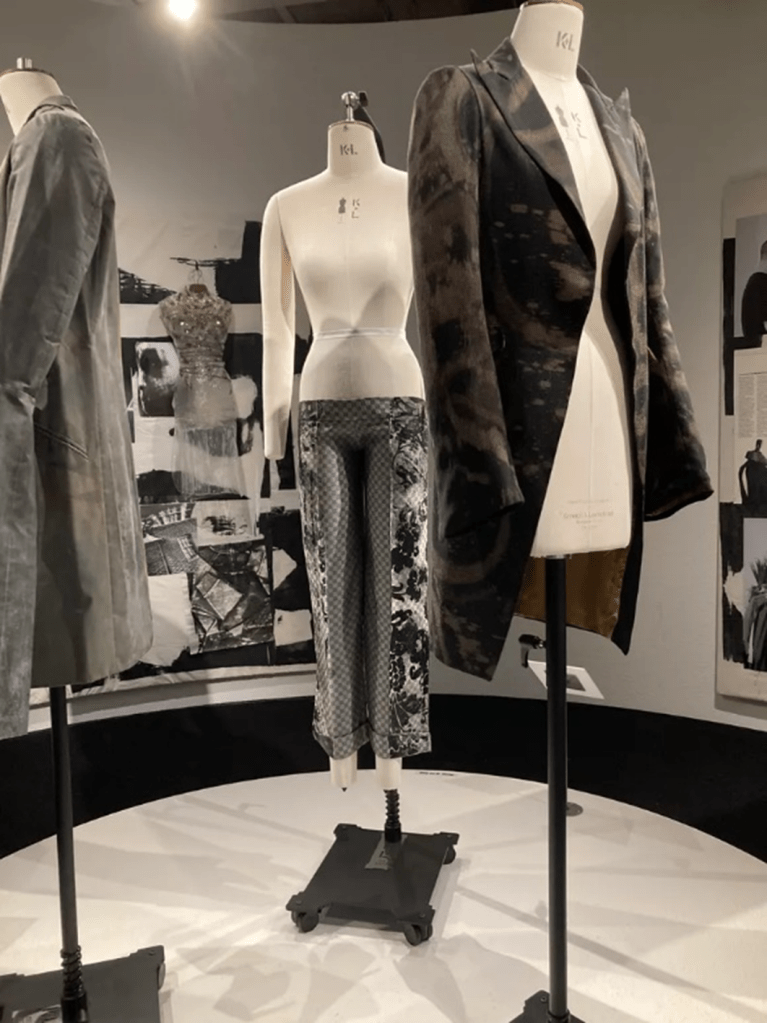
After a linear timeline of the UK cultural zeitgeist from the 90s to now, a small circular room instantly caught my attention. This room was a small exploration into the works of Alexander McQueen; from the clothes themselves to the gay nightlife that gave him his creative spark. McQueen himself was one of the first recipients of the BFC’s own ‘NEWGEN’ scheme, created to support designers at a time when the UK was in economic distress (‘The British Fashion Council’, 2016). With this in mind, the room and his brand’s sponsorship of the exhibit could not have been more appropriate and the effort from Mower and Lewin clearly shows. From his signature monochromatic colour scheme to his out-of-the-box creations, everything screams signature McQueen making it recognisable to even those unfamiliar with his works. Even more interesting than the works themselves are the flyers and photos on the wall beside them, all of which paint a vivid picture of the city’s nightlife that had an evident impact on who McQueen would become.
‘Art School’ And NEWGEN-
Just opposite of McQueen’s room came Mower and Lewin’s celebration of the designers of today with ‘Art School’. While the exterior’s drab white exterior may seem unappealing at first glance, it can be interpreted that this was entirely Mower and Lewin’s intent, a mundane school-like interior housing fantastical creations paralleling many an art school across the city. Inside these monotone white walls house some of the exhibit’s most visually exciting garments, all coming from recent graduates from the aforementioned NEWGEN scheme (Lewin & Mower, 2023).
Not only are the garments incredibly detailed and bursting with individual flair, but some even have recognisable origins that even those outside the fashion world can recognise. From SS Daley’s oceanic flared trousers seen on Harry Styles’ Golden cover to Molly Goddard’s flowy blue tulle gown worn by Rihanna, it’s a clear sign that success after university life is still achievable despite the government’s continual neglect of the arts (Reyburn & Shaw, 2023). Each wall circling the designs is decorated with quotes all relating to a desire for more, a willingness for success in the outside world which anyone can relate to and empathise with. This helps to create a sense of reliability in an area otherwise dominated by the outlandish and surreal. Mower’s background working with education institutes and her ideology that education brings out individuality brings a sense of nuance and respect to the room that none of the others possess (Hess, 2023).
Club Life and The Nightlife Revolution-
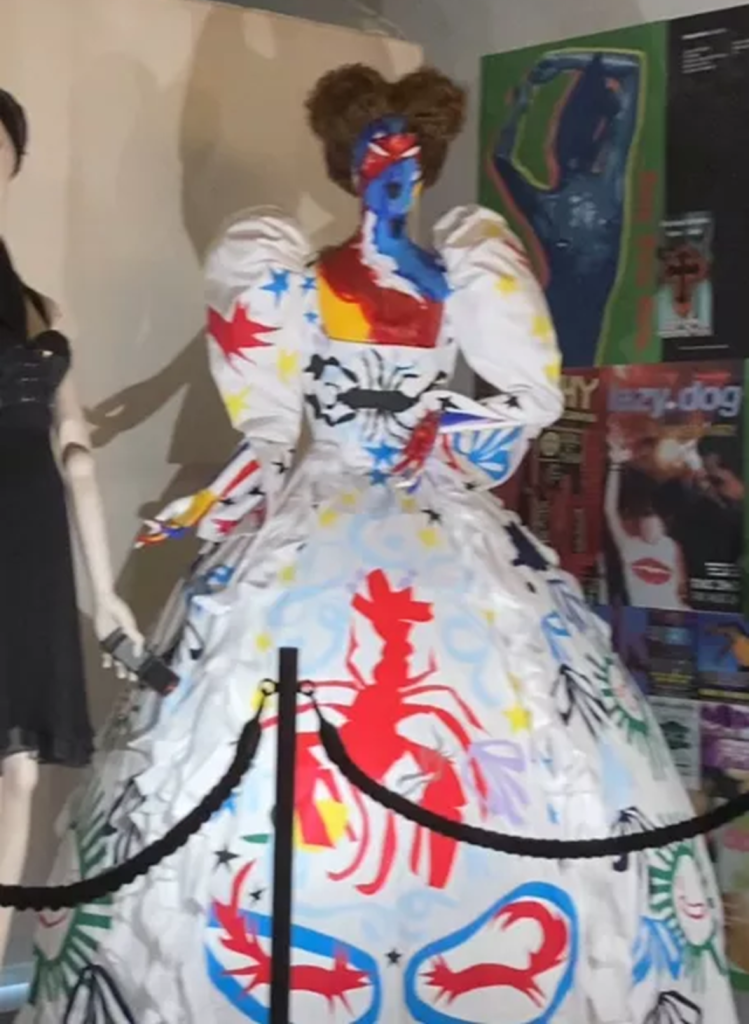
Across the corridor of the art school came its more punk and daring counterpart. ‘Club Scene’ arguably contains the exhibit’s most recognisable creations including Bjork’s divisive swan look from the Oscars and Sam Smith’s balloon bodysuit from the Brits. It can be easy for the other looks to fade into the background besides these two titans of rebellious fashion, but Mower and Lewin cleverly chose vivid and striking outfits that clash well with the previous two’s monochrome colour schemes. Charles Jeffrey’s lobster gown in particular is a true feast for the eyes- the classic silhouette decorated with graphic illustrations can easily symbolise the punk movement itself- reinventing elements of the past to rebel against the status quo of the present. Recognition also has to be given to the hair and makeup on the mannequins curated by NEWGEN alumn Nasir Mazhar (Davidson, 2023); the addition of similar graphic faces added some much-needed unity to the designs almost as if they’re from the same collection.
Whilst examining the mannequins, I noticed the thrashing sounds of techno garage coming from the room next door. The accompanying curtain took us into a scree room featuring archival footage from the clubs of the 90s where the clubbing scene burst into popularity. While some may dismiss using these films as lazy and superficial, I feel that it was the best approach to convey that era to modern audiences. The graininess of the footage coupled with the noisy music that defined the era conveys the uniqueness of said era more than any recreation ever could. Although it would have been nice to have seen some sort of theming or decoration around the room to enrich the experience.
Catwalks And Change-Makers-
After ‘Backstage Pass’, featuring various accessories and Instagram makeup filters, it felt as though the exhibit had reached its peak. Not to say the aforementioned room had any horrible qualities and was visually unappealing, but it felt as though Mower and Lewin were relying far too much on trendy gimmicks rather than letting the art speak for itself. Although the filters did lead to some comical results.
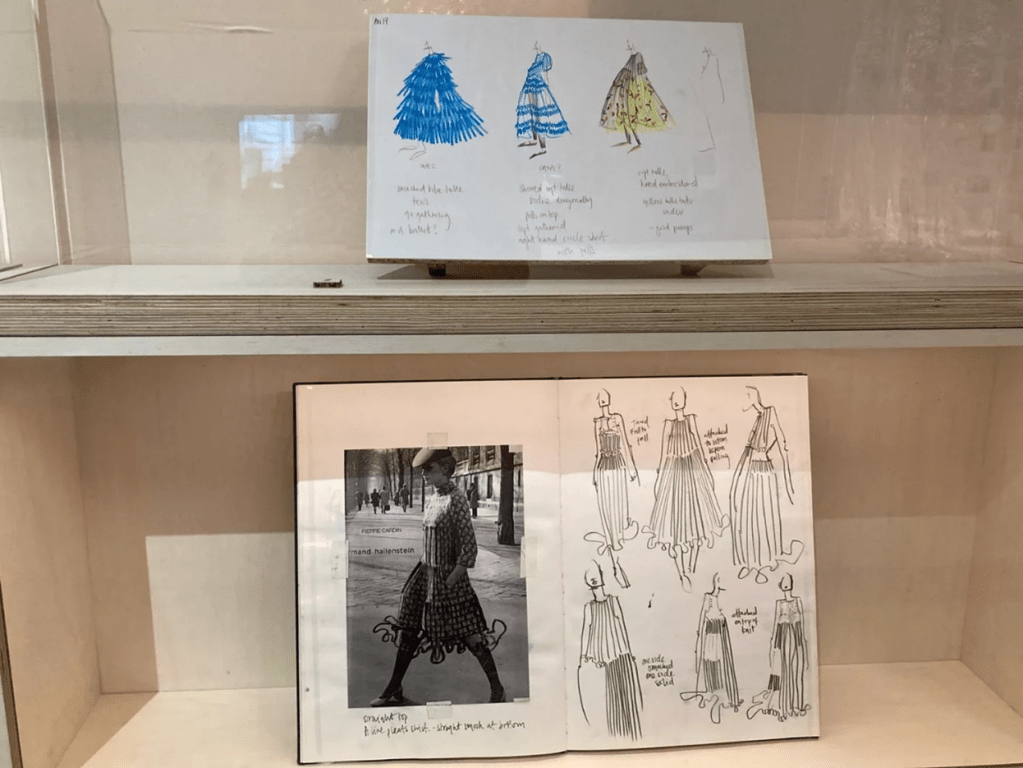
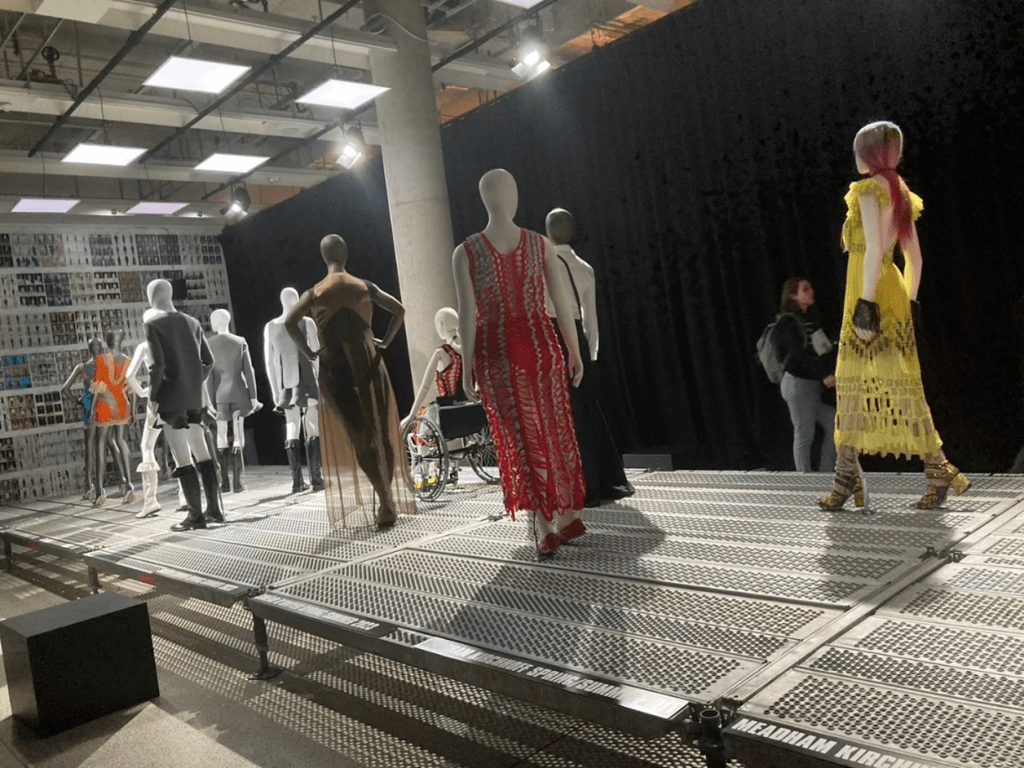
With that being said, I found the runway section next door to be a return to form. Not only was the set-up highly immersive and atmospheric, but the collections on display showcased a more polished side of the rebellious movement while holding onto the same spirit. Featuring flashy lighting and projected screens, Mower aimed to ‘let audiences experience the same chills as those who saw the runways at the time’ (Hess, 2023). While it may be impossible to recapture that fanatic spark completely, I do think their effort to do so clearly shows creating a successful final product. From the colourful and diverse collections, the detailed sketches passing me by and the photo wall at the back; it felt like walking through the creative process from concept to fashion week.
With this return to form, my expectations were high for the last room as a satisfying end to my experience. Unfortunately, that did not happen. While ‘Change-Makers’ did display some interesting designs and examples of new-age 3d printing fashion, I felt as though the room lacked an obvious flowing theme that connected these looks. Every other room felt like garments were purposefully put there to build upon the visual narrative and were a clear visual representation of a sector of London rebel fashion. With ‘Change-Makers’ however, I needed additional context to understand what the room was trying to convey (that being showcasing female designers), which for a visual experience is a negative sign. At the very least, the gift shop next door helped to levitate my disappointment with a nicely themed assortment of collectables and merch.
Conclusion-
In summary, I would consider ‘Rebel- 30 years of London fashion’ to be a solid success as a celebration of the past and present of London’s counterculture and the people who defined it and reinventing it today. Mower and Lewin have successfully been able to tell the tale of the designers who changed London’s fashion landscape thanks to their immersive curation that crafted an engaging visual story. From the video screens to historical artefacts, each element came together to create a visual and audio treat that allowed me to see just how talented and inspiring this new multicultural generation of designers is.
However, as someone already interested in fashion history, I may have gotten more out of the exhibit than those who lack any interest. This was proven by a group of friends I went to the exhibit with who all found the experience ‘rather mundane and boring’, especially compared to the more luxurious Gucci Cosmos we visited earlier on. This may mean the experience lacks universal appeal and can only be enjoyed by those with a prior interest in fashion. This isn’t to mention my grievances with the exhibit, such as the lack of context for some areas and a disappointing final section that lacked identity.
Overall, at a time when the art industry (Khomami, 2022) and education sector (Reyburn & Shaw, 2023) are in an unfortunate decline, it’s wonderful to see such a poignant reminder of its importance to London’s culture that’s accessible to anyone of all cultures and generations. Not only did Mower achieve her goal of evoking London’s culture to the audience (Hess, 2023), but I truly think her and Lewin’s collaborative effort will inspire NEWGEN’s next wave of success stories in the not-too-distant future.
Written By Abbie Matthews
Bibliography-
• Davidson, C. (2023) Inside the immersive exhibition ‘Rebel: 30 Years of London Fashion’, Shift London. Available at: https://www.shiftlondon.org/fashion/a-look-into-the-immersive-rebel-30-years-of-london-fashion/
• Hess, L. (2023) Inside a new exhibition celebrating 30 years of Newgen and the irrepressible energy of London Fashion, Vogue. Available at: https://www.vogue.com/article/rebel-30-years-of-london-fashion-design-museum-london
• Khomami, N. (2022) Arts funding cuts ‘cultural vandalism’, says Juliet Stevenson, at DCMS protest, The Guardian. Available at: https://www.theguardian.com/culture/2022/nov/22/arts-council-england-cuts-are-cultural-vandalism-says-juliet-stevenson
• Lewin, R. & Mower, S. (2023). Rebel- 30 Years of London Fashion (Exhibition of Fashion and Design). Exhibited at the design museum September 16th 2023-11th February 2024.
• Reyburn, S. and Shaw, A. (2023) Private sector picks up the pieces as UK government cuts art education funding, The Art Newspaper – International art news and events. Available at: https://www.theartnewspaper.com/2023/09/19/private-sector-uk-government-cuts-art-education-funding
• The British Fashion Council – Google Arts & Culture (2016) Google. Available at: https://artsandculture.google.com/story/the-british-fashion-council-british-fashion-council/DgVBhh8FFEpCJw?hl=en
• Turner, F.S. (ed.) (2023) Rebel: 30 Years of London Fashion Exhibition debuts at the Design Museum, YouTube. Available at: https://www.youtube.com/watch?v=PPOd27I09LA&t=7s
• All photos in the review were photographed by me.
 Abbie Matthews
Leave a comment